


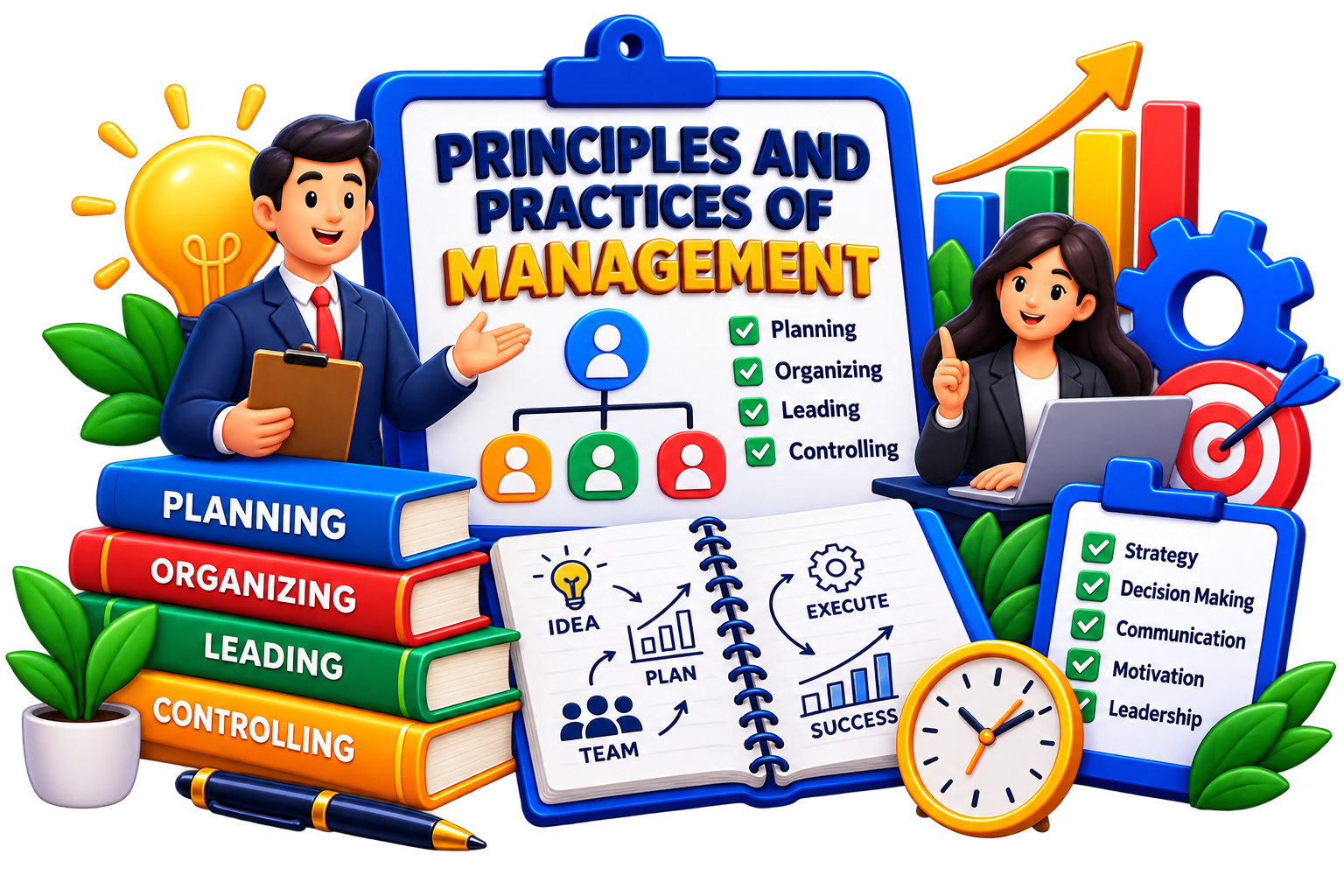

Management in Indian Knowledge Tradition
Management in Indian ethos, Indian models, spiritual values and management, and the modern concept of management — meaning, definitions, importance and functions.
Explore Unit ➜Principles and Practices of Management introduces the core ideas behind managing organizations. It helps you understand Indian and modern management thought, and the key functions of planning, organizing, staffing, directing and controlling.

Each unit contains curated notes, diagrams, important questions and more.
Management in Indian ethos, Indian models, spiritual values and management, and the modern concept of management — meaning, definitions, importance and functions.
Explore Unit ➜Meaning, definitions, importance, types and process of planning, planning vs forecasting, Management by Objectives (MBO), strategies and policies.
Explore Unit ➜Meaning, definitions and importance of organization, organizational structures and departmentalization, organizational behaviour, authority and responsibility.
Explore Unit ➜Meaning and sources of recruitment, selection process, interviews, evaluation and placement, and training — meaning and types.
Explore Unit ➜Meaning, definitions, objectives and nature of directing, and the meaning, definitions, types and process of controlling.
Explore Unit ➜A complete study resource built around the DAVV BBA exam pattern.
These Principles and Practices of Management notes for BBA DAVV follow the official syllabus of Devi Ahilya Vishwavidyalaya, Indore, topic by topic. From management in the Indian knowledge tradition in Unit 1 to directing and controlling in Unit 5, every concept is explained in simple language so you can understand the "why" behind each topic, not just memorize definitions.
Build a strong foundation with our Unit 1 notes covering management in Indian ethos, Indian models of management, spiritual values and management, and the modern concept of management — its meaning, definitions, importance and functions.
Understand the types and process of planning, the difference between planning and forecasting, Management by Objectives (MBO), and the role of strategies and policies, with clear examples in our Unit 2 notes.
Learn about organizational structures and departmentalization, organizational behaviour from Indian and Western perspectives, and the concepts of authority and responsibility, explained in an exam-friendly way.
Explore the recruitment process, sources of recruitment, selection process, interviews, evaluation and placement, and the meaning and types of training of employees.
Master the meaning, objectives and nature of directing, along with the types and process of controlling, the final functions that turn plans into results in every organization.
Every unit includes Principles and Practices of Management important questions commonly asked in DAVV BBA semester exams, so you can revise efficiently in the final days before your exam without missing high-weightage topics.
Quick answers about Principles and Practices of Management notes for BBA DAVV students.
The DAVV BBA Principles and Practices of Management syllabus is divided into 5 units: Management in Indian Knowledge Tradition, Planning, Organization, Recruitment of Employees, and Directing & Controlling.
Yes, all Principles and Practices of Management notes for BBA DAVV are completely free to read on CampusNotes directly on the website — no login, signup, or payment required.
There are 5 units in DAVV BBA Principles and Practices of Management: Management in Indian Knowledge Tradition, Planning, Organization, Recruitment of Employees, and Directing & Controlling.
Unit 2 covers the meaning, definitions, importance, types and process of planning, the difference between planning and forecasting, Management by Objectives (MBO) with its meaning, definitions and process, and strategies and policies.
Yes, CampusNotes is fully mobile-friendly, so you can study Principles and Practices of Management notes on any device without downloading anything.