
UNIT 1
Introduction to Micro Economics
Definition and meaning of Micro Economics, inductive and deductive methods, importance and limitations of Micro Economics.
Explore Unit ➜Micro Economics studies how individual consumers, producers and markets make decisions. It helps you understand demand, elasticity, production, costs, market structures and how prices and incomes are determined in the economy.




Each unit contains curated notes, diagrams, important questions and more.
Definition and meaning of Micro Economics, inductive and deductive methods, importance and limitations of Micro Economics.
Explore Unit ➜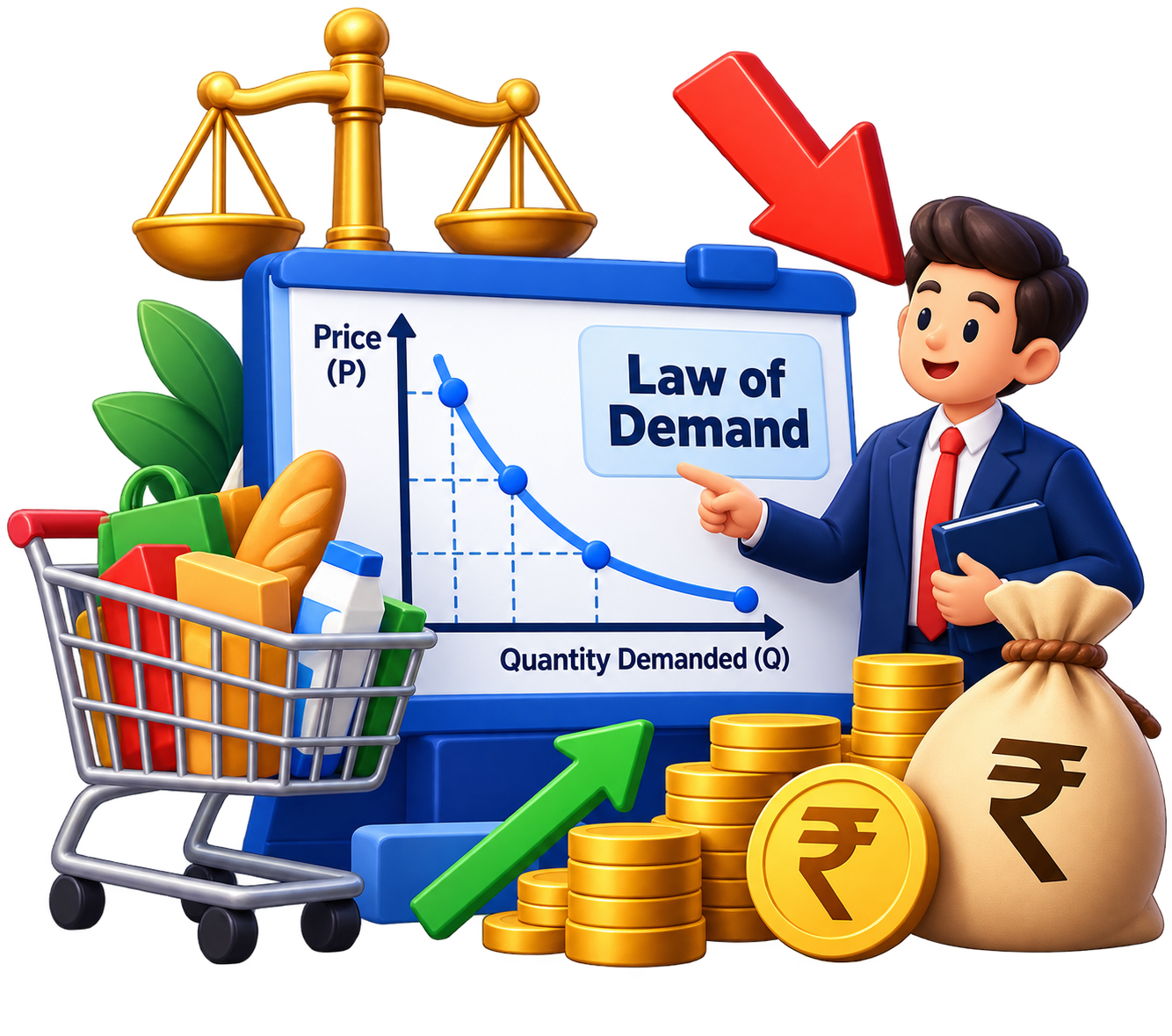
Meaning and definition of the law of demand, its characteristics, types of demand and the exceptions to the law of demand.
Explore Unit ➜
Concept, definition, importance, types and measurement of elasticity of demand, production function with one and two variables, and internal and external economies.
Explore Unit ➜
Land, labour, capital, organization and enterprise as factors of production, along with cost and revenue analysis.
Explore Unit ➜
Concept, definition, characteristics and classification of markets, price determination under perfect and imperfect competition, and the marginal productivity theory of distribution.
Explore Unit ➜A complete study resource built around the DAVV B.Com exam pattern.
These Micro Economics notes for B.Com DAVV follow the official syllabus of Devi Ahilya Vishwavidyalaya, Indore, topic by topic. From the basics of Micro Economics in Unit 1 to market structure and distribution in Unit 5, every concept is explained in simple language so you can understand the logic behind each theory, not just memorize definitions.
Build a strong foundation with our Unit 1 notes covering the meaning and definition of Micro Economics, the inductive and deductive methods of economic analysis, and the importance and limitations of Micro Economics.
Get a clear understanding of the law of demand, its characteristics, the different types of demand and the exceptions to the law of demand in our Unit 2 notes, with examples and diagrams that are frequently asked in exams.
Understand the concept, types and measurement of elasticity of demand, the production function with one and two variables, and the difference between internal and external economies.
Learn about land, labour, capital, organization and enterprise as factors of production, and go through cost and revenue analysis with simple explanations and numerical examples.
Go through the concept, characteristics and classification of market structures, price determination under perfect and imperfect competition, and the marginal productivity theory of distribution, explained in a clear and exam-friendly manner.
Every unit includes Micro Economics important questions commonly asked in DAVV B.Com semester exams, so you can revise efficiently in the final days before your exam without missing high-weightage topics.
Quick answers about Micro Economics notes for B.Com DAVV students.
The DAVV B.Com Micro Economics syllabus is divided into 5 units: Introduction to Micro Economics, Law of Demand, Elasticity of Demand with Production Function and Economies, Factors of Production with Cost and Revenue Analysis, and Market Structure with the Marginal Productivity Theory of Distribution.
Yes, all Micro Economics notes for B.Com DAVV are completely free to read on CampusNotes directly on the website — no login, signup, or payment required.
There are 5 units in DAVV B.Com Micro Economics: Introduction to Micro Economics, Law of Demand, Elasticity of Demand with Production Function and Economies, Factors of Production with Cost and Revenue Analysis, and Market Structure with the Marginal Productivity Theory of Distribution.
Unit 3 covers the concept, definition, importance, types and measurement of elasticity of demand, the production function with one and two variables, and internal and external economies.
Yes, CampusNotes is fully mobile-friendly, so you can study Micro Economics notes on any device without downloading anything.